
TCAE+G
Total Cost of AI Execution + Governance
TCAE+G (Total Cost of AI Execution + Governance) is a CFO-focused framework for evaluating the full cost of AI execution, including software, usage, implementation, workflow redesign, training, adoption, governance, accountability, measurement, and ongoing operating costs.
Most AI discussions focus too narrowly on software costs, use cases, or expected productivity gains. CFOs need a broader view — the Total Cost of AI Execution and Governance.
Software costs and use cases only tell part of the story. The real cost of AI execution includes implementation, adoption, governance, and ongoing operating expense.
Finance leaders need to understand the Total Cost of AI Execution and Governance — not just the price of the tools — to evaluate AI-related opportunities, understand organizational implications, and scale AI responsibly. TCAE+G provides the structure for that evaluation.
The TCAE+G Framework helps CFOs evaluate AI initiatives through the lenses of economics, execution, adoption, and governance, bringing greater structure and discipline to AI-related decisions.
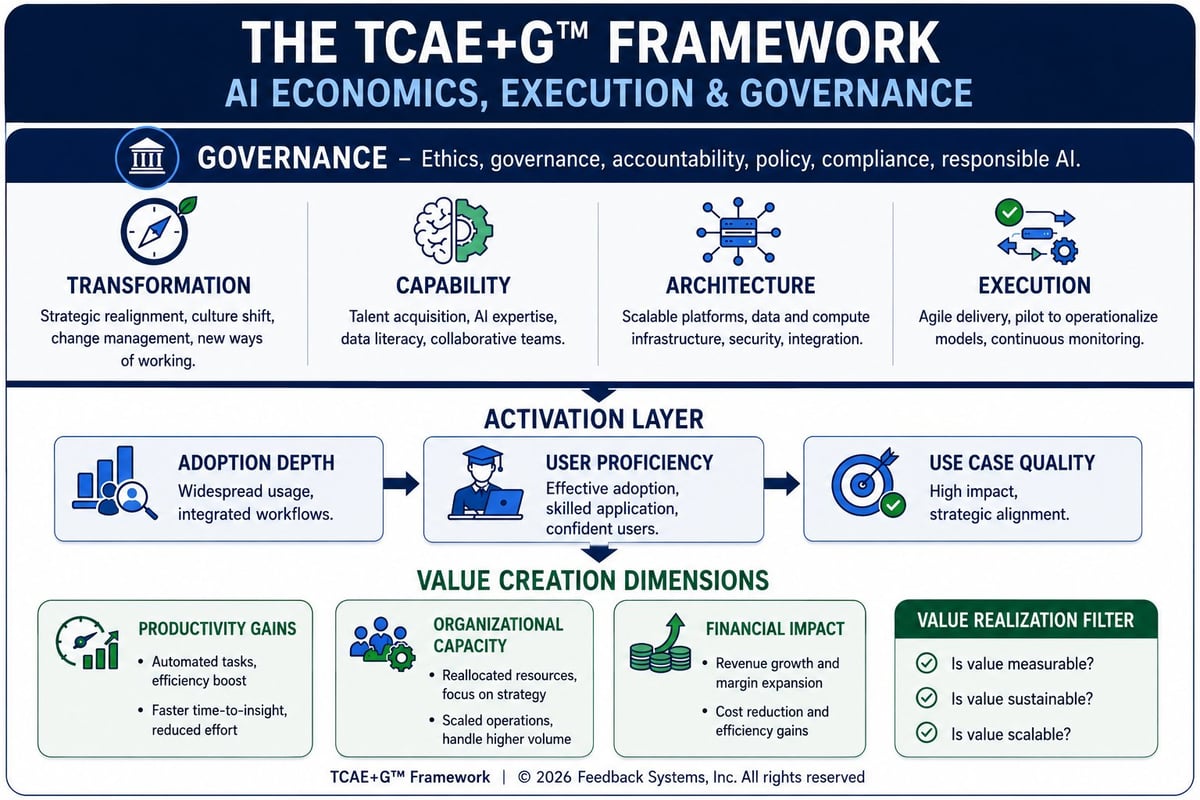
Dimensions of the TCAE+G Lens
Ten Dimensions CFOs Should Evaluate
Understand the full licensing model — seats, tokens, usage tiers, platform fees, and how costs scale as usage grows. The headline price rarely reflects what the organization will actually pay at scale.
Evaluate what it will take to integrate AI into existing systems, data environments, and workflows. Integration complexity is one of the most consistently underestimated costs in AI business cases.
Assess how processes, roles, and operating procedures will need to change. AI tools rarely slot into existing workflows cleanly — they require deliberate process redesign to deliver value.
Factor in the investment required to train employees, drive consistent adoption, and manage the behavior change that determines whether AI tools are actually used.
Identify the internal resources — people, time, expertise — that will be consumed by implementation, oversight, and ongoing management of AI initiatives.
Pressure-test vendor ROI projections, performance claims, and contractual terms. Scrutinize pricing escalators, renewal obligations, data usage rights, and service-level commitments.
Examine what data the AI system requires, how it will be accessed, where it will reside, and what data governance obligations the organization assumes.
Define who owns AI decisions, how outputs are reviewed, what documentation is required, and how accountability is assigned across the organization.
Test whether projected productivity gains are realistic, measurable, and net of the time required for training, oversight, rework, and workflow adjustment.
Model the consumption-based pricing dynamics unique to AI — token usage, API calls, inference costs — and the ongoing operating expenses that continue long after implementation.
Why the TCAE+G Lens Matters
AI discussions often focus on vendor claims, software costs, or isolated productivity metrics. The TCAE+G Lens provides CFOs with a structured lens for evaluating the economic, operational, adoption, and governance considerations associated with AI initiatives.
It is designed to help finance leaders apply consistent financial discipline and evaluation criteria when assessing AI-related opportunities and decisions.
Explore the CFO AI Decision Review SuiteWhat Most AI Business Cases Miss
Many AI business cases focus primarily on software pricing and expected productivity gains. While these numbers are important, they capture only a fraction of the total investment required to make AI work inside a real organization.
What is frequently missing: the implementation effort required to integrate AI into existing systems, the workflow redesign needed to change how work actually gets done, the workforce adoption investment without which tools go unused, the governance framework that protects the organization, organizational readiness assessment, measurement infrastructure to track whether value is being realized, ongoing operating costs that continue indefinitely, and execution risk — the gap between what the vendor promises and what the organization can actually absorb.
Why License Cost Is Not Total Cost
Software licensing represents only a fraction of the total investment required to make AI work in a real organization. CFOs who evaluate AI on license cost alone risk significantly underestimating the financial commitment.
The full picture includes implementation and systems integration, change management, employee training and upskilling, governance and oversight, ongoing monitoring and optimization, data preparation and quality assurance, vendor management, internal project management, and the long-term operational costs that continue year after year. Each of these categories can represent a material investment — and together they often exceed the software cost itself.
CFO Questions Before Approving an AI Investment
Before approving funding for an AI initiative, CFOs should pressure-test the business case with questions that go beyond the vendor pitch and the project champion's enthusiasm.
What assumptions drive the projected ROI, and how sensitive is the business case to changes in those assumptions?
What costs are not included in the business case — and why were they excluded?
What workflows, roles, and operating procedures must change for this initiative to deliver value?
How will adoption be measured, and what happens if adoption falls short of projections?
Who owns governance and accountability for AI decisions, data usage, and output quality?
How will success be measured — and what is the baseline before implementation begins?
What ongoing operating costs should be expected after implementation, and who bears them?
What execution risks should be considered — including vendor dependency, data exposure, integration failure, and organizational capacity constraints?
Hidden Cost Categories
AI implementation costs extend well beyond the visible line items in a project budget. CFOs should look for these commonly overlooked cost categories when evaluating any AI investment proposal.
Workflow redesign
Redesigning how work is done — not just adding AI to existing processes — requires process mapping, stakeholder alignment, and operational restructuring.
Employee training
Beyond initial onboarding: ongoing skill development, prompt engineering, output review, and building AI literacy across teams.
Change management
Communication, leadership alignment, resistance management, and the deliberate effort required to shift established ways of working.
Data preparation
Cleaning, structuring, labeling, and maintaining the data AI systems depend on — often the most labor-intensive phase.
AI governance
Policies, decision rights, review processes, documentation standards, and the organizational infrastructure for responsible AI use.
Compliance requirements
Regulatory obligations, audit readiness, data protection, and industry-specific requirements that add cost and complexity.
Internal project management
The internal resources required to coordinate vendors, stakeholders, timelines, and deliverables across the implementation lifecycle.
Vendor management
Ongoing oversight of vendor performance, contract compliance, pricing changes, and relationship management.
Ongoing support and optimization
Continuous monitoring, model updates, prompt refinement, performance tuning, and user support beyond the initial deployment.
Organizational readiness
Assessing whether the organization has the capacity, culture, and leadership alignment to absorb AI-driven change.
AI as a Capital Allocation Decision
AI investments should be evaluated as capital allocation decisions, not simply technology purchases. The discipline CFOs apply to major capital projects — rigorous ROI analysis, scenario planning, risk assessment, governance requirements, and post-investment measurement — belongs at the center of every AI funding decision.
CFOs should concentrate investment on AI initiatives that create measurable business value, evaluate the full cost of execution before committing, pressure-test ROI assumptions against realistic adoption and timeline expectations, and ensure governance is in place before AI scales across the organization. Approaching AI as a capital allocation decision — rather than an IT procurement exercise — elevates the quality of the conversation and the defensibility of the decision.
How TCAE+G Supports Board-Ready Decision Making
The TCAE+G framework helps CFOs translate AI investment decisions into the language of the boardroom: cost, risk, return, governance, and organizational readiness. It provides a consistent structure for evaluating AI initiatives with the same financial discipline boards expect for any major capital commitment.
Using the framework, CFOs can evaluate AI initiatives with greater financial discipline, identify hidden costs before they appear as budget variances, pressure-test vendor claims against operational realities, improve executive communication with a clear evaluation structure, and prepare for CEO and board discussions with greater confidence. The result is not just better AI decisions — it is stronger executive judgment, clearer accountability, and more defensible recommendations when the board asks the hard questions.
Resources for CFOs Evaluating AI
Services
Side-desk AI advisory, decision reviews, governance assessments, and vendor evaluations for CFOs.
Learn moreAI Decision Review Suite
Fixed-scope advisory reviews for AI investment readiness, governance, and vendor decisions.
Explore offersAI Advisory FAQ
Answers to common CFO questions about AI advisory, scope, engagement, and expected outcomes.
Read FAQCFO AI Round Tables
Private peer discussions where finance leaders compare notes on AI strategy, governance, and execution.
View sessionsEvaluate Your Next AI Initiative with TCAE+G
Schedule a confidential conversation to discuss how TCAE+G can help you evaluate an upcoming AI investment with greater financial discipline, identify costs the business case may be missing, and prepare a stronger recommendation for your CEO, board, or executive team.
Schedule a Confidential ConversationTCAE+G is a proprietary framework developed and used by CFO AI Advisors.